Harvested Lives
Time is the rarest gift we are given, and the only one we are trained not to notice as it disappears. We speak of it casually, as if it belongs to us, as if it can be managed, saved, made more efficient, as if it is not, in fact, the substance of our lives. But time does not bend to intention. It yields to structure.
And if I am honest about the structure of my own life, the truth is both simple and unbearable.
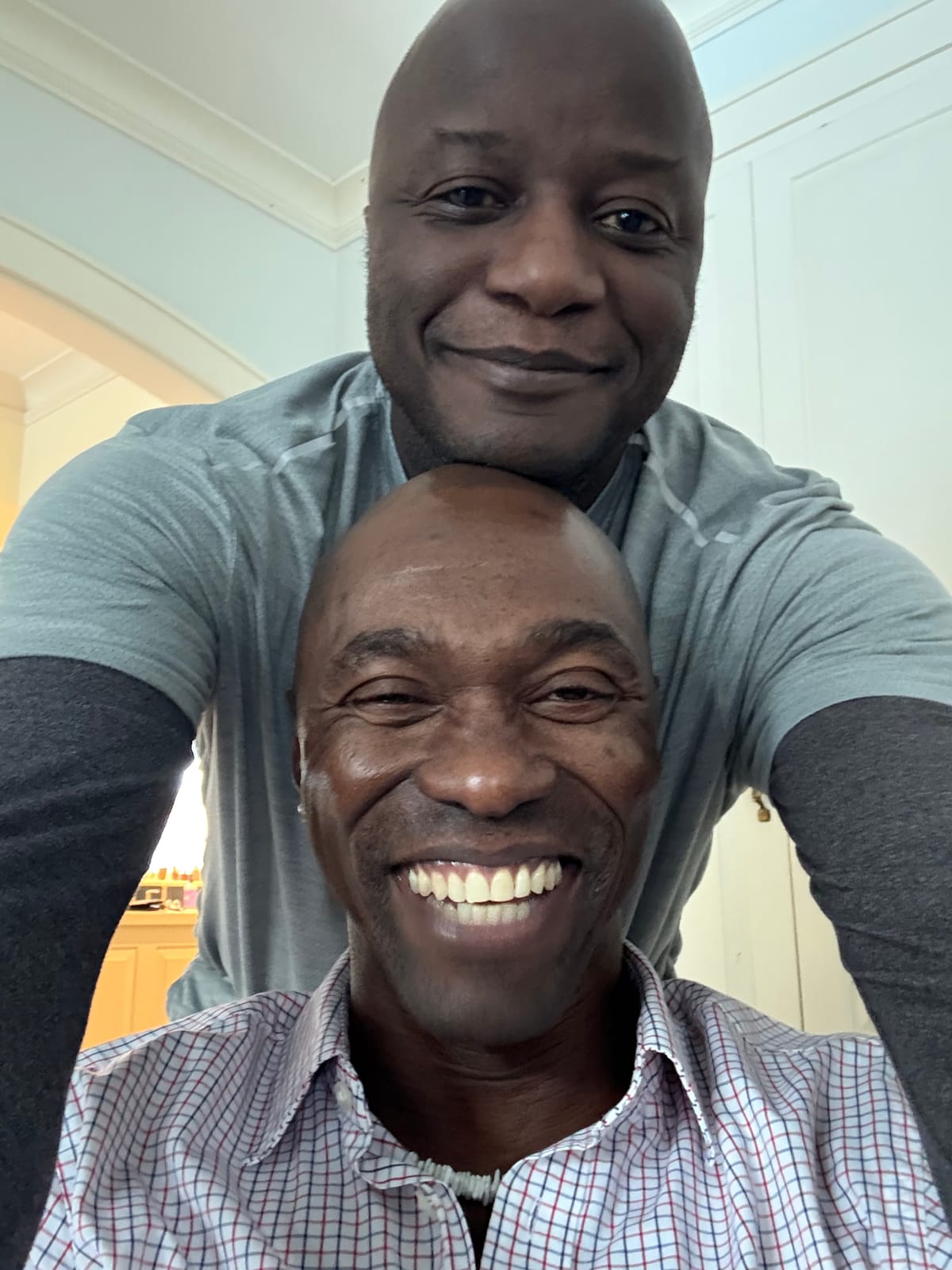
I was thinking about time recently when a good number of my friends came in to celebrate the Fallon-Kayiwa table (Sorry Jimmy!) My friend here lives in Illinois. I live in New York. Somewhere along the way, we learned to call that distance normal. We learned to call absence adulthood. We have both been living the lives we were told to build, working, moving, accomplishing, always in motion.
Right before this picture he was sitting across from me, close enough that I could see what time had changed since the last time I had been this near. Not in any grand way, not in the kind of change that announces itself, but in the faint places. I noticed it before I meant to. The way you notice something you cannot unknow. And once I saw it, I could not stop seeing it.
It unsettled me, not because of what it said about him, but because of what it said about us. About how long it had been since I had really looked at him. Not through a screen, not in passing, not in the brief and hurried exchanges we call staying in touch, but like this, in stillness, with nothing between us but the space we had chosen to share. The gray in my hair had not arrived suddenly. It had come slowly, over days I had not witnessed, across months I had not been present for, inside a life I was supposed to be a part of.
And sitting there, I realized that what I was seeing was not just age. It was time I had not lived fully. Somewhere in the middle of that realization, I began to do the math, not as an exercise but as a kind of reckoning. If we see each other twice a year, (keep in mind we don't), and if each visit lasts four days, that is eight days a year. From now until eighty, if we are fortunate enough to reach it, that is three hundred and thirty six days. Less than a single year of my remaining life spent in the physical presence of someone I've known all my life and love.
It is a number that resists comprehension until you allow it to settle into the body. It holds the conversations we will not have, the ordinary afternoons that will never arrive, the slow and necessary work of knowing another person that is supposed to make a life feel shared. Sitting there with him, I understood that this distance was not accidental. It was not simply the byproduct of growing older. It was the result of how our lives have been arranged, how our time has been claimed, how our attention has been directed away from one another and toward something else entirely.
What unsettled me most was not the smallness of that number, but how familiar it felt. Because this is not simply a matter of me and him. It is a pattern so ordinary we have stopped recognizing it as a pattern at all. It is the friend you promise to see more often and somehow never do. It is the parent whose voice becomes something you hear mostly through a device. It is the child who grows in increments you witness only in photographs. It is the partner you share a home with but not a day, passing each other in the narrow hours between obligation and exhaustion, speaking in logistics instead of love.
We have been taught to accept this thinning of our lives as the price of being adults, as though distance were inevitable and not arranged, as though absence were natural and not produced. We say we are busy, and what we mean is that our time no longer belongs to us. We say we are tired, and what we mean is that something has taken more from us than we ever intended to give. The language softens the reality, but the reality remains. The people we love are reduced to appointments. Presence becomes something scheduled, negotiated, postponed.
And the hours of our lives, the very substance of what it means to live, are spent elsewhere, in service of demands we did not fully choose but have come to obey.
If this were only my story, it might be easier to dismiss. But it is not. It is everywhere, visible in the grief of missed moments and the practiced acceptance of lives lived at a distance from what matters most. We feel it, even when we cannot name it. We carry it, even when we pretend not to notice. And once you begin to see it, once you allow yourself to ask why so much of your life has been given over to everything except the people and the presence you claim to value, the question that emerges is not only personal. It is structural. It is societal.
Your time was taken—shaped, measured, and accounted for long before you were ever asked what you believed a life should be.
This is not new. It is only more refined. There has always been a relationship between power and the control of human time, between wealth and the ability to decide how other people live their days. What has changed is not the impulse, but the method. Where control was once visible, it is now ambient. Where it once required force, it now requires belief. We have inherited a system that has learned how to extract not only labor, but attention, not only effort, but identity. And because it no longer announces itself as domination, we have learned to call it normal.